We’re officially living in the midst of a pandemic and almost everyone has been materially affected. Industries have been turned on their head and in some cases virtually collapsing overnight. Jobs have been lost and businesses shut. And, sadly, lives have been lost, too.
The impact on business and our daily lives has been immense and will continue for the foreseeable future.
Business and marketing plans have been up-ended or scrapped altogether. Whilst marketing budgets mostly have been pared back in line with operating revenues, it’s imperative now more than ever that you don’t lose your voice, manage your reputation and provide clear information and solutions.
Don’t stop communicating
Your customers need to still hear from you, now’s not the time to disappear from view, no matter how tough things are.
Stay visible and engaged, it will help when we come out the other side. Everyone will need to rebuild and those that have maintained their profile and been as positive as possible will be better placed in this regard. Your customers will maintain their trust in you and appreciate hearing about your journey.
People are feeling vulnerable right now and an empathetic approach is critical. Choose your tone carefully and impart your own lessons learned with simple advice. Keep up your regular content marketing program and engage with your customers across your platforms – your owned channels will be even more important to you.
Be authentic
Consumers now more than ever will recognise authenticity and true purpose. Feel-good content that alleviates anxiety and promotes positive messaging will go a long way to enhancing your brand. But a word of warning, you need to show that your contributions are material and not solely for commercial benefit. No one expects you to have all the answers, but ensure you can back-up what you say you will do. Being able to deliver on your promises is crucial. Examine your brand voice to see if it’s still appropriate or should be tweaked for the times.
You are more likely to be remembered for your kindness and generous acts.
Be agile and adapt
Many people are engaging and interacting online for the first time and for others, their online habits are being reinforced and deepened.
You should consider what content people need and pivot with your creative messages accordingly. Listening and talking with your customers will give you immediate feedback about their needs and what they’re looking for from you.
Online marketing spend will increase naturally and take priority over many traditional forms of advertising spend.
Social advertising spend will increase as people turn to their most trusted brands online for reassurance and reliable useful information.
Importantly, track trends, measure sentiment and behaviour and adapt to the new way of working. Devise your plans for life beyond this pandemic and understand the impact on your industry and business and be prepared to lead in new ways.
The speed and reach of the Coronavirus crisis will be felt for decades. While we are all struggling to assess the impact on us personally, we also have organisations that have obligations and responsibilities to staff, customers and other stakeholders.
Establishing and maintaining clear lines of communication with these stakeholders is one of the most important roles of leadership and management during this crisis. Conveying a sense of calm and control will position your business to return to normal as quickly as possible when (not if) the crisis ends.
Here are some simple things to remember while communicating.
Health & Wellbeing Is Your First Priority
While the long-term economic impact of the crisis is occupying a great deal of people’s thoughts, we are still in the middle of a major, global health emergency. Your first obligation is to create a safe workplace. The number of cases of COVID-19 in Australia is still rising and we must do everything possible to reduce the spread to save lives. ‘Flattening the curve’ is our collective responsibility.
Until we have the virus under control, all your actions and communications with stakeholders MUST put health and wellbeing first. Always provide the information and resources your stakeholders need to meet their social obligations to stopping Coronavirus.
Don’t be an Expert
The Federal Government, State Government and health authorities are moving quickly to provide detailed, authorative information about Coronavirus to the public. Do not rely on your own experts, your ‘sister’s brother who is a GP’ is not an expert. When advising staff and customers about how to respond to the crisis utilise the range of free information available.
Don’t be afraid to remind your stakeholders that there are still positives. The virus is under control in many countries and Australia has a strong, resilient economy with the capacity to absorb even the biggest shock.
The current health crisis is TEMPORARY, and we are days or weeks from getting on top of it. People need reminding that there are reasons to be optimistic so don’t be afraid to talk up your recent successes or the underlying strength of your industry.
The situation is changing on a daily basis. The last thing your stakeholders need is an information vacuum, which they will fill with information from unreliable sources and their imagination.
Create the systems, processes and disciplines to communicate on a daily (or twice daily) basis. Send an email to staff at the same time each day, either first thing in the morning or at 5.00pm each evening. Assign responsibility and make sure this communication comes from a trusted, senior executive who has the primary responsibility for managing the crisis.
Create a Dedicated Blog or Webpage
This crisis could go on for weeks or months. Creating a dedicated ‘warehouse’ where you can host and share information is one way to bring some order to the chaos. In a quickly moving situation, having a centralised location where updates and the latest information can be compiled is key to avoiding confusion. Many organisations have already created landing pages dedicated to providing information about the coronavirus and their mitigation efforts.
We recommend that clients place a link to this dedicated page on the homepage of their website. Key information to include on the page:
Information about whether or not any of your employees or locations have been exposed to the virus. While you should not identify employees, it is important to communicate whether there are any active or monitored cases tied to your organisation or facilities.
Details about your contingency plans. If you serve clients in-person, include information about whether your locations are open or not and how you will or will not serve clients if you close.
Preventative measures that are underway. If your organisation is encouraging employees to work from home, reduce nonessential travel, implement additional cleaning procedures or take any other precautions to minimise the risk of exposure, share these details.
Links to external resources like those listed above.
A statement that the webpage reflects the situation as it currently stands and as this is a rapidly evolving situation, your organisation will continue to evaluate the best course of action and update the page with the latest information as it is available.
Contact information for your primary media spokesperson and leadership team member overseeing Coronavirus preparedness.
Equip Your Staff
Successful communication starts with employees and internal stakeholders. They are always your best public relations people, and public relations people always do best with a good briefing.
Now is the time for CEOs and top executives to communicate with employees and stakeholders and reassure them by stating the steps the organisation is taking. He/she should record an organic (not highly produced) 60-second video—on a current model smart phone—describing the current state of affairs, steps being taken (to disinfect surfaces and protect people), what is planned next and why.
This video can supplement such written communications as direct mail pieces, emails, texts, and social posts.
Assign People to Create Content
You should quickly appoint a dedicated person or team to take charge of creating and updating your response content, including fact sheets, media statements, Q&As and EDMs
In a rapidly changing environment, it is vitally important all your communication is time stamped. What is true now, may not be tomorrow, so treat all communication as a ‘point in time’ exercise.
Don’t fuss too much about style guides or templates. Your stakeholders will forgive you if your documents are not up to your usual high standards of design and presentation. It is the substance that matters. It is OK to compromise on these to ensure timely and consistent communication.
Prepare for Media Enquiries
Consider the immediate development of media statements for key events/risks that you may be faced with. These statements can be provided to media who make an enquiry, be posted on your website and social media channels. They are important too for your employees and other stakeholders.
Consider the communications needed for the closure of an office or facility, staff member(s) contracting the illness, or unavailability of a key product or service.
Clear communication is necessary, as is the provision of updates as required. Ensure consistency in the nominated spokesperson and tone of voice.
Be Reactive and Engaged on Social Media
In the confusion of managing a business during a crisis, some of the simple things often get forgotten. Monitoring and responding to social media enquiries is sometimes the first victim of threat assessment.
It’s vital that your team are focused on social monitoring during a time of crisis. Any negative social media mentions should be dealt with immediately and with consistency. Any questions should be answered quickly and respectfully. There should be sections of your plan dedicated solely to social media crisis management.
We are all entering a new world, but many of the old rules for effective communication remain. Be open, honest and proactive. Your stakeholders will reward you for it.
Australia’s lack of toilet paper has made headlines this week thanks to the COVID-19 Coronavirus, with frenzied shoppers fighting (literally) for the last remaining packs of dunny rolls in some sort of feverish, dystopian battle royale.
Coronavirus refers to a family of virus that contain the common cold, bronchitis and other respiratory infections including SARS. What makes COVID-19 hazardous is it’s ability to transfer from animals to humans, it’s ability to mutate rapidly, and that no vaccine exists for it at present.
What COVID-19 doesn’t do is cause spectacular, prolonged bouts of diarrhoea that would necessitate the need for the entire country to go out and buy their bodyweight in toilet paper.
Why are people stocking up on toilet paper?
Due to our reliance on overseas production of literally everything, pandemic lockdowns have had significant impacts on supply chains worldwide. Uninformed masses picked up on a Hong Kong based political journalist that reported that toilet paper supply would be affected. Now we all get to experience the absolute depths of human depravity in an aisle designed to clean up our undesirable actions.
Should you stock up on toilet paper too?
No. Obviously if you’ve run out at home, you’re probably 💩 out of luck now, but there is no point in committing to a selfish bulk buy. Only 40% of our toilet paper is imported from overseas, but for those of us who care about what we wipe our bums with, Kimberly-Clark (Kleenex) has Australian manufacturing facility with ample supply and 24-hour manufacturing.
Selfie from a Kimberly-Clark worker in their warehouse.
Why all the hype?
We are social creatures, and a crisis like this (perpetuated by the media and the government’s insistence on multiple daily press conferences) is prompting the most anti-social behaviour in recent memory. Fear of missing out (FOMO) due to a supply:demand imbalance is a key motivator for any kind of hype. After all, nobody wants to resort to using a sock or ice-cold bidet.
It goes without saying that we have a herd mentality when it comes to objects or concepts that we as a community deem desirable, from necessities like toilet paper, to novelty or luxury items like handbags or shiny precious metals, even intangible things like intellectual property or cryptocurrency (or fiat currency for that matter).
Tulip Mania
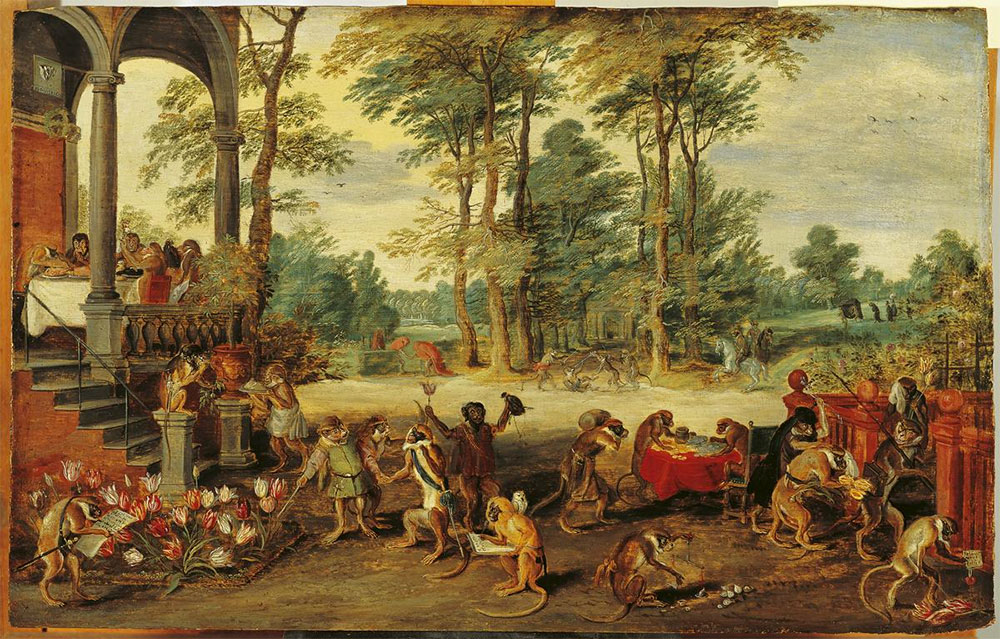
Hype doesn’t stop – or start – with toilet paper, the earliest noteworthy instance of baseless stock shortfall triggering this kind of panic was “Tulip Mania”. Tulip Mania was a dark time in 17th Century Holland where the humble tulip flower was the must-have item to prove your social status – or what the kids nowadays call clout.
Tulip bulbs fetched nearly 10 times a person’s annual salary at their peak, and due to scarcity the resale market was the primary cause of skyrocketing prices. Tulips take nearly a decade to flower from a seed, so bulbs naturally fetched a premium.
The tulip bubble lasted less than half a year, with Dutch investors wallowing in a pit of worthless tulip bulbs they paid so much for.
A Satire of Tulip Mania (Jan Brueghel the Younger (1640)) depicts tulip maniacs as brainless monkeys.
Sick Shoes, Bro
In more recent times, Bitcoin was proclaimed by many to be the modern equivalent of Tulip Mania, which has been covered ad nauseam by nearly every blog on the internet.
I’m a big sneaker fan, so I am at the coalface of the sneaker hype ecosystem in my spare time. The sneaker resale game is a US$2 billion dollar market that is projected to reach US$6 billion by 2025.
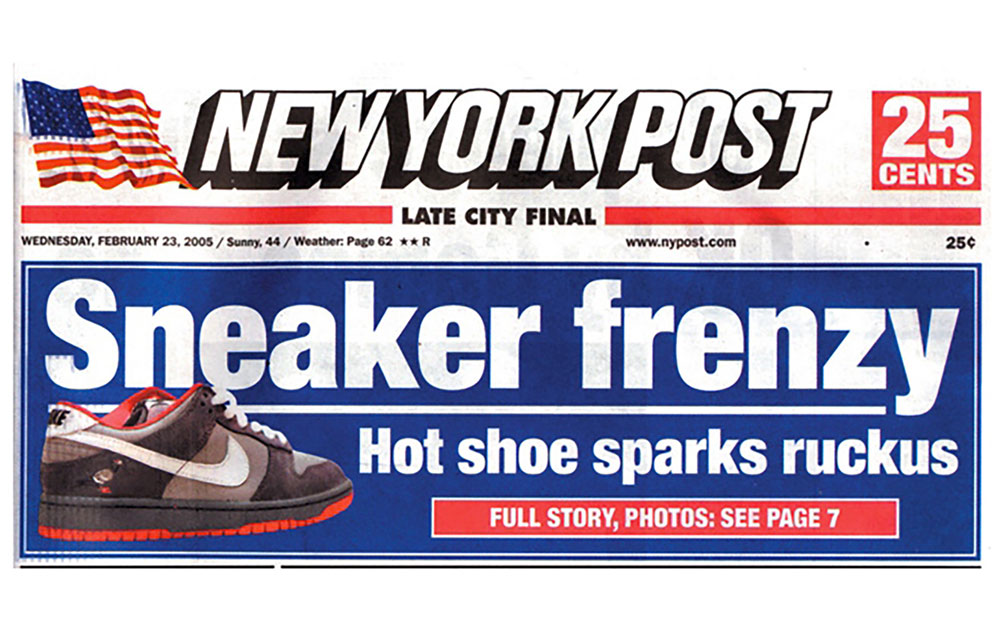
Jeff Staple’s Nike SB Dunk “Pigeon” release sparked riots in New York in 2005.
Jeff Staple made headlines in 2005 when he released his Nike SB Dunk “Pigeon” with sneakerheads lining up around the block for a chance to buy a pair of these limited edition shoes. Riots were reported over these pigeon-emblazoned kicks which now sell for over AU$20,000 on sneaker resale marketplaces like StockX.
In the 15 years since, the demand for limited edition shoes has only increased, with heavyweight collaborators like Michael Jordan (Basketball the legendary Nike Air Jordan), Virgil Abloh (Off-White and Louis Vuitton Creative Director), Kanye West (Rapper turned reality TV husband), Travis Scott (Rapper and owner of giant inflatable version of his own head) and the late Kobe Bryant all carving out a significant chunk of the industry with their own signature shoe lines.
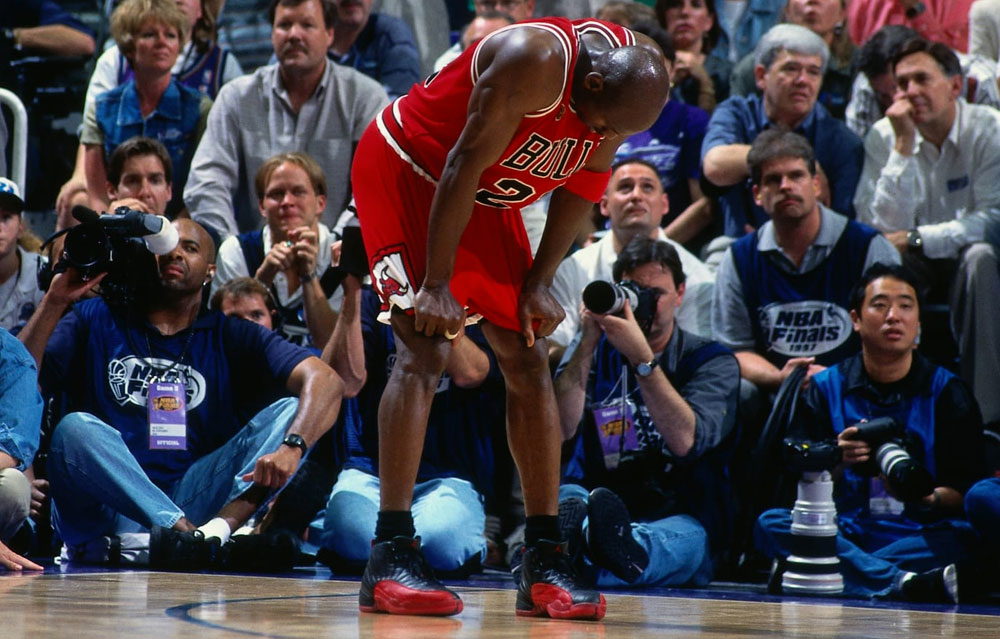
A very sick Michael Jordan during the legendary Game 5 comeback victory in 1997. His Airness wears a pair of “Flu Game” Jordan 12’s which maintain a cult following. Sick shoes indeed.
Stop, Collaborate and Listen
Hype transcends the shoe and personal hygiene industries, retailers worldwide have taken the collaborative bull by the horns and successfully leveraged it for products as mundane as homewares. Flat-pack furniture and sales maze juggernaught IKEA frequently collaborate with creatives worldwide. Most recently was a collaboration with Off-White’s Virgil Abloh in November.
IKEA x Virgil Abloh MARKERAD collection featuring a wet grass rug, giant IKEA receipt, paper bags and a broken mirror.
IKEA’s foodcourt was packed, and it wasn’t for $1 hot dogs.
The turnout was huge, I got there half an hour before the launch was due to start and IKEA had already allocated all of the tickets they had allocated for the products an hour before I got there. More than 20 people had camped out overnight to get their hands on furniture, which featured a backlit Mona Lisa, a chair with a doorstop on one leg, and a green shag pile rug with “WET GRASS” written on it.
Gordon, a hype reseller who does this full time.
I met up with Gordon, a reseller who quit his day job to attend releases like this as his primary source of income. Gordon has a contract with a sneaker resale store in Brisbane and has been lining up for things professionally for over 18 months.
Before the first half of the allocated numbers had been called, the Mona Lisa had already sold out. By the end of the day, the only items remaining were a small IKEA toolkit with a “HOMEWORK” embellishment on the lid. Clearly hypebeasts aren’t the DIY type.
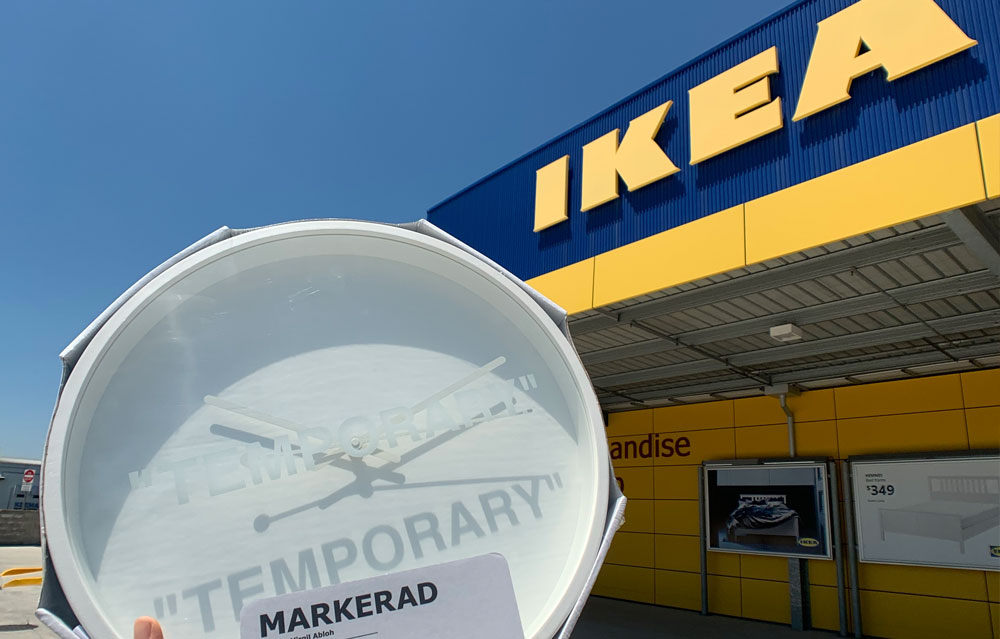
You’ll be pleased to know that Gordon got me my clock, which I’m not too proud to admit that I paid a premium on over RRP – but that’s par for the course when it comes to the resale market.
My MARKERAD clock, featuring Virgil Abloh’s trademark quotation marks which are both fashionable and incredibly difficult to use as an actual clock.
Befriend The Bar Keeper
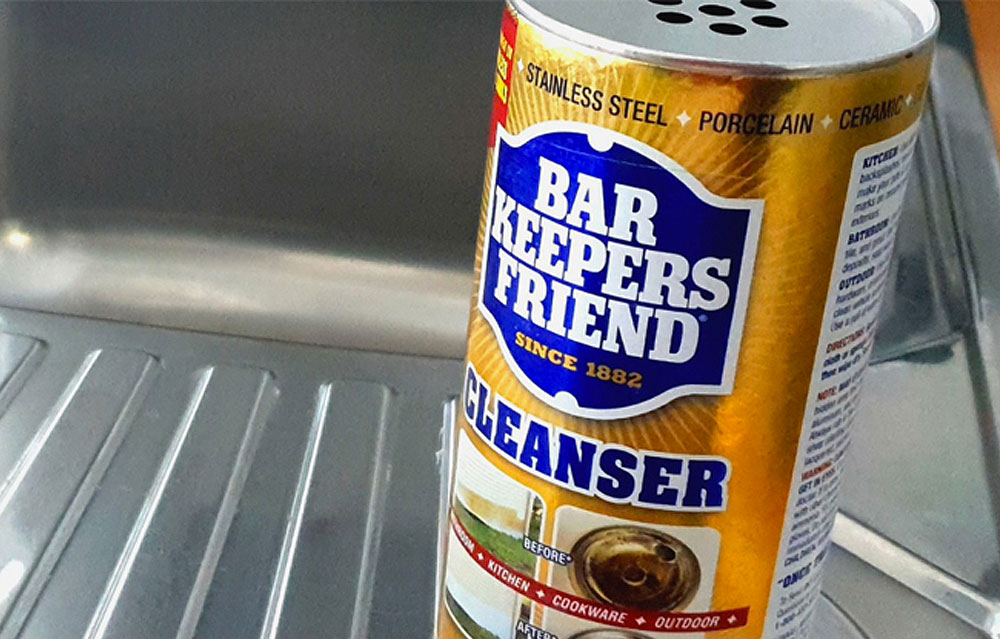
Switching back to grocery store wars for a quick final case study, Bar Keepers’ Friend is a canned abrasive cleaning powder that has been produced since 1882. It had a humble single facing allocation in the cleaning aisle in your local supermarket, but then something strange happened earlier this year.
Bar Keepers’ Friend, still relevant in 2020 after nearly 140 years.
Social media discovered that this humble little can could do the unthinkable: it could obliterate the calcified buildup on your shower screens and brighten the kitchen sink with minimal effort. Consequently, the $8 can has been sold out for months despite assurances from Coles and Woolworths that they will meet demand.
Will Barkeeper’s Friend attract a 4-pack-per-customer limit or will it go the way of the tulip? Either way, retailers are cleaning up on the hype.
If the COVID-19 panic is getting you down, here is an incredible Simpsons mashup to lighten the mood:
You might have fallen for someone’s attempt to disinform you about current events. But it’s not your fault.
Even the most well-intentioned news consumers can find today’s avalanche of political information difficult to navigate. With so much news available, many people consume media in an automatic, unconscious state – similar to knowing you drove home but not being able to recall the trip.
And that makes you more susceptible to accepting false claims.
But, as the 2020 elections near, you can develop habits to exert more conscious control over your news intake. I teach these strategies to students in a course on media literacy, helping people become more savvy news consumers in four simple steps.
1. Seek out your own political news
Like most people, you probably get a fair amount of your news from apps, sites and social media such as Twitter, Facebook, Reddit, Apple News and Google. You should change that.
These are technology companies – not news outlets. Their goal is to maximize the time you spend on their sites and apps, generating advertising revenue. To that end, their algorithms use your browsing history to show you news you’ll agree with and like, keeping you engaged for as long as possible.
That means instead of presenting you with the most important news of the day, social media feed you what they think will hold your attention. Most often, that is algorithmically filtered and may deliver politically biased information, outright falsehoods or material that you have seen before.
Instead, regularly visit trusted news apps and news websites directly. These organizations actually produce news, usually in the spirit of serving the public interest. There, you’ll see a more complete range of political information, not just content that’s been curated for you.
Untrustworthy news and political campaigns often use statistics to make bogus claims – rightfully assuming most readers won’t take the time to fact-check them.
Simple mathematical calculations, which scholars call Fermi estimates or rough guesstimates, can help you better spot falsified data.
For instance, a widely circulated meme falsely claimed 10,150 Americans were “killed by illegal immigrants” in 2018. On the surface, it’s hard to know how to verify or debunk that, but one way to start is to think about finding out how many total murders there were in the U.S. in 2018.
Murder statistics can be found in, among other places, the FBI’s statistics on violent crime. They estimate that in 2018 there were 16,214 murders in the U.S. If the meme’s figure were accurate, it would mean that nearly two-thirds of U.S. murders were committed by the “illegal immigrants” the meme alleged.
Next, find out how many people were living in the U.S. illegally. That group, most news reports and estimates suggest, numbers about 11 million men, women and children – which is only 3% of the country’s 330 million people.
Just 3% of people committed 60% of U.S. murders? With a tiny bit of research and quick math, you can see these numbers just don’t add up.
3. Beware of nonpolitical biases
News media are often accused of catering to people’s political biases, favoring either liberal or conservative points of view. But disinformation campaigns exploit less obvious cognitive biases as well. For example, humans are biased to underestimate costs or look for information that confirms what they already believe. One important bias of news audiences is a preference for simple soundbites, which often fail to capture the complexity of important problems. Research has found that intentionally fake news stories are more likely to use short, nontechnical and redundant language than accurate journalistic stories.
Also beware of the human tendency to believe what’s in front of your eyes. Video content is perceived as more trustworthy – even though deepfake videos can be very deceiving. Think critically about how you determine something is accurate. Seeing – and hearing – should not necessarily be believing. Treat video content with just as much skepticism as news text and memes, verifying any facts with news from a trusted source.
You won’t – and shouldn’t – believe what Barack Obama says in this video.
4. Think beyond the presidency
A final bias of news consumers and, as a result, news organizations has been a shift toward prioritizing national news at the expense of local and international issues. Leadership in the White House is certainly important, but national news is only one of four categories of information you need this election season.
Informed voters understand and connect issues across four levels: personal interests – like a local sports team or health care costs, news in their local communities, national politics and international affairs. Knowing a little in each of these areas better equips you to evaluate claims about all the others.
For example, better understanding trade negotiations with China could provide insight into why workers at a nearby manufacturing plant are picketing, which could subsequently affect the prices you pay for local goods and services.
Big businesses and powerful disinformation campaigns heavily influence the information you see, creating personal and convincing false narratives. It’s not your fault for getting duped, but being conscious of these processes can put you back in control.
Podcasting is not new. However, what was once seen as a niche and hobbyist medium has well and truly gone mainstream.
The art of audio storytelling has seemingly been given a shot in the arm through this format and embraced by content producers equally, from those at the kitchen table through to the larger media houses.
Many people first became aware of them when Apple over 15 years ago first offered over 3,000 free podcasts on iTunes. According to Forbes, there are now over 800,000 active podcasts with over 54 million podcast episodes available globally.
With low production costs and few barriers to entry, podcasting as a medium is available to nearly everyone. The popularity of portable music players and smartphones has only made accessibility to podcasts easier.
Michele Levine, chief executive of research firm Roy Morgan, said podcasts are growing in popularity in Australia with nearly 10% of Australians now downloading audio or video podcasts in an average month:
“Podcasts are a relatively new part of the media landscape but are making an increasing impact as audiences for the service are on a steady growth track up an impressive 70% over the last four years to over 1.6 million Australians in 2019.
“The ability to listen to your favourite podcast while commuting to and from work and tuning out from the hustle and bustle on crowded public transport, or just relaxing in your spare time to catch up on what’s been happening in an area of personal interest is appealing to a growing number of Australians.”
Podcast rankings
As the attention of advertisers and brands follows, the seemingly fragmented world of podcasting and audience measurement is becoming more ordered, particularly with radio heavyweights embracing the platform.
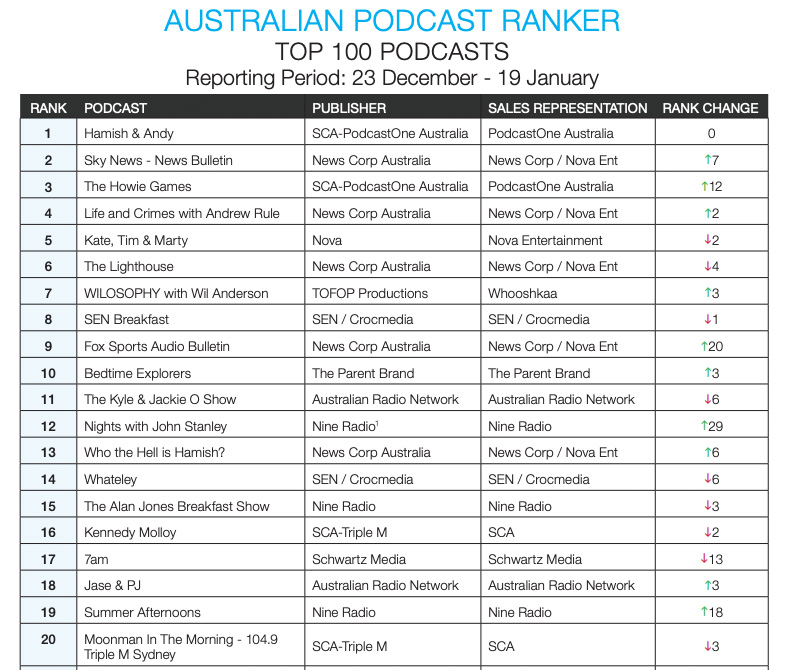
Late in 2019, Commercial Radio Australia (CRA) announced the launch of the first monthly Australian Podcast Ranker which sees Australia’s top 100 most-downloaded and listened to podcasts ranked each month. The monthly rankings can be accessed here.
The ranking was launched with a foundation group of podcast publishers including News Corp Australia, Podcast One Australia, Nova Entertainment, Southern Cross Austereo (SCA), Australian Radio Network (ARN), Macquarie Media and SEN/ Crocmedia.
The rankings are dominated by our larger entertainment groups, with many familiar names including Hamish and Andy at the top. True crime is continually popular with News Corp Australia’s series of crime podcasts ranking highly including The Nowhere Child and Who the Hell is Hamish?
How can podcasting benefit your brand?
Have you considered podcasting as a means of engaging with your customers and seeking out new audiences? A podcast may well fit in with your brand strategy and content marketing program and provide the following benefits:
Reach new audiences
Podcasting can help you reach new audiences, especially through recommendations and referrals from satisfied listeners. If your podcast provides relevant and informative listening chances are that others will value your show, even if they’re not currently a customer.
Building relationships with an audience
Even though a podcast provides a largely one-way stream, it’s a great way to speak directly to your audience and is considered quite a personal medium, much like quality radio programming. The audience has elected to opt in, so you have a good opportunity to keep their attention.
Make your brand more real
If you avoid the temptation of the hard sell and instead provide an informative listening experience and make your listeners feel part of a community then your engagement levels will be high and this will be reflected in brand trust and confidence.
Accurate Analytics
The digital medium allows you to accurately measure engagement by tracking key statistics which may include, amongst others:
Writing great content that generates traffic, engagement, backlinks, shares and leads is the holy grail of content marketing.
While there is still no simple recipe, one of the great benefits of the massive amount of content produced and the growth of analytical tools to review results has been a much better understanding of what works and what doesn’t.
We now know with more clarity than ever how to write great content.
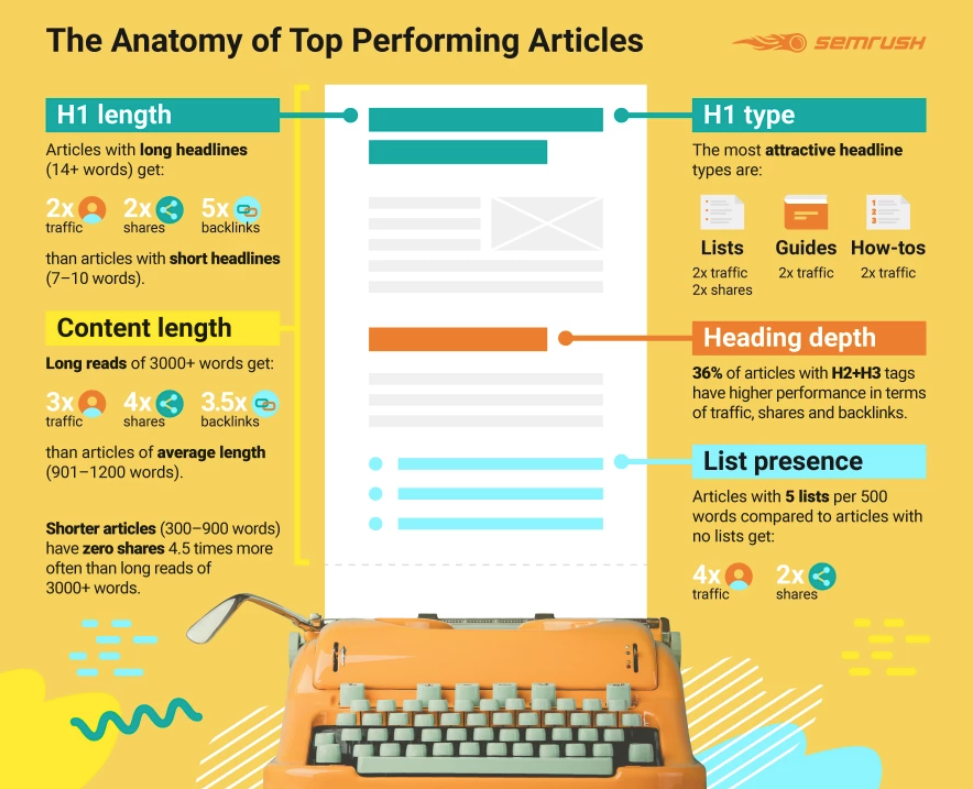
The results were not great for lovers of short articles. It showed pages and blogs of more than 3,000 words getting 3x the traffic, 2x the shares and 3.5x more backlinks than articles of average length. Short articles (less than 200 words) are not shared at all 4.5x more often than long reads.
The length of headlines is also critical to engagement. Articles with long headlines (14+ words) get 3x more traffic, 2x more shares and 5x more articles with short headlines (7-10 words).
The reason for the popularity of long reads is contested by it is safe to assume that as the sheer number of content pieces grows, readers are increasingly being more selective and taking deeper dives.
The length of a ‘long’ article continues to get longer as well. In 2014, HubSpot tallied the averages of all of its 6,000+ blog posts and derived that there is a “positive correlation between high performing pages within organic search and word counts over 2,250 words”. Just five years ago SEMRush’s sweet spot rested right between 2,250 and 2,500 words.
If the thought of writing 3,000 (or 2,500) words makes you draw a deep breath, thankfully there is an alternative view.
According to research done by popular blogging platform, Medium, the ideal length for blog posts is 1,600 words (or seven minutes of reading). This result is based on an analysis of the “average total seconds spent on each post and compared this to the post length.” Their research found that up to the seven minute/1,600 wordmark, readers average time spent looking at the post increased, plateauing at the seven-minute mark, and quickly declining after that point.
While length is important, how you use it is also critical. The most important thing to remember is that quality content is what really matters. 5,000 words of dribble will not get anywhere near the result of 500 words of highly-targeted, useful content.
Are Listicles Still Important?
There is a reason listicles have spread like a rash across the internet. They work. According to SEMrush, listicles get the most shares and traffic (up to 2x more than other blog types), followed by guides and “how to” articles.
Why do they work? They allow our brain to digest information in a very digestible way. Modern media assaults us with a never ending stream of content. Our brains simply do not have the capacity to sort through the massive volume of information and store in a useful place for easy recall later.
“With the tsunami of incoming stuff, our brains will automatically try to find a sorting mechanism and try to make sense of it. So we naturally gravitate to the listicle. Finally! the brain says. A writer who has actually organized thoughts into some semblance of order. The brain sees organization and says, Right, let’s read it.”
Think About Structure
The structure of your article is also critical to understanding, as well as having incredible SEO value. SEMrush identified that well-structured articles with h2 and h3 are more likely to be high-performing. More than one in three articles with h2 and h3 tags have high performance in terms of traffic, shares and backlinks.
Header tags are an important on-page SEO factor because they’re used to communicate to the search engines what your website is about. Search engines recognise the copy in your header tags as more important than the rest. This starts with your h1 and works its way down in importance to the h2, h3 and so on. These tags will help support the overall theme or purpose of your page.
The content of your tags is just as critical as actually using them. Make sure you are stuffing your header tags with short-tail and long-tail keywords. As search engines crawl your site, they will pick up on the headers and recognise the keywords you are using as important.
This article has been structured to index for search traffic that is using the search term “Tips For Writing Great Content In 2020″
My h1 = <h1> Top Tips For Writing Great Content In 2020 </h1>
My h2 = <h2> Writing Great Content Means Lots Of Writing</h2>
My h3 = <h3>Are Listicles Still Important</h3>
As you can see, I used my h1 to capture the overall theme of the post since it represents what’s most important. I then used my h2 as a subheading to reinforce my h1 and overall theme. The same can be said about my h3 and how it relates to my other headings and overall theme.
The most important tip for writing great content (keywords!) is to give yourself plenty of time to write plenty of words, come up with a great headline, make it a list of something and use your header tags.
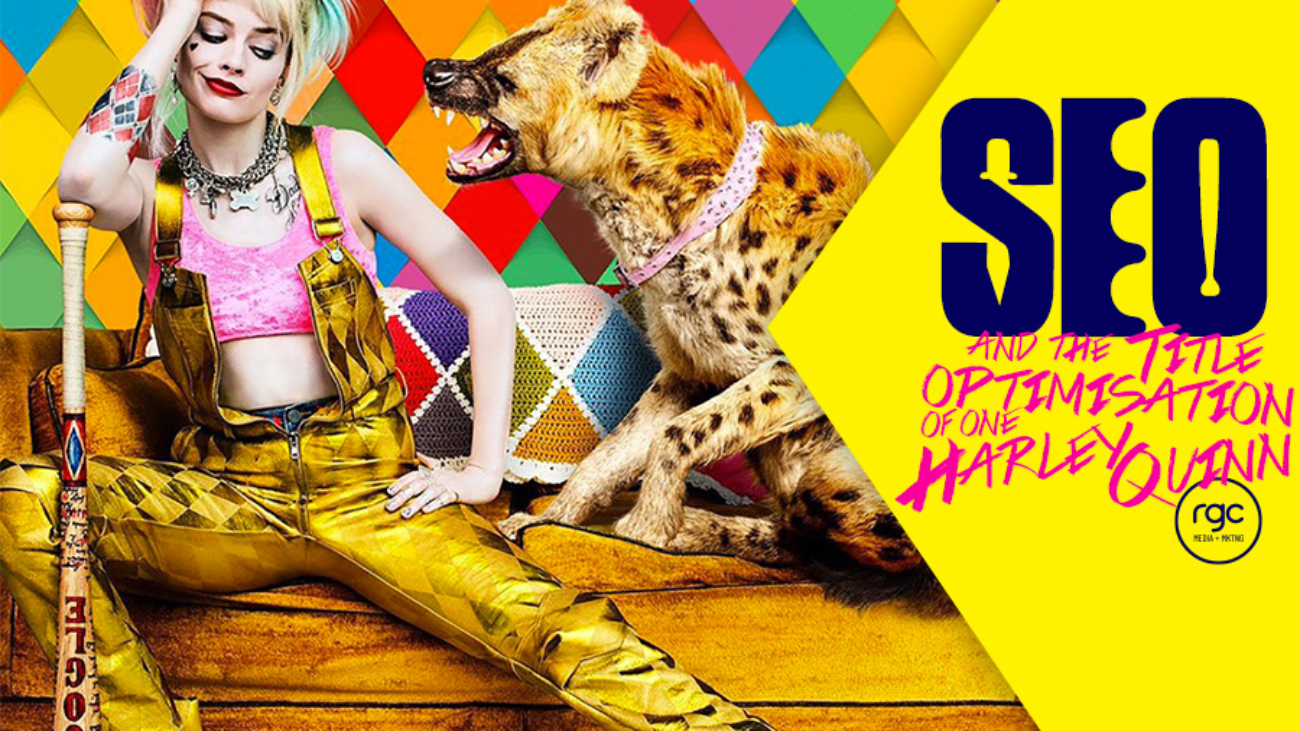
Warner Brothers have hit the rename button on their mouthful of a title for the new Harley Quinn film, citing “search expansion for ticket sites” as their motivation.
It’s not often you have a post-release change to anything as large as a feature film, especially for the purposes of SEO.
Without critiquing the movie itself, let’s just get stuck into exactly how critical your title structure is to give your content the best chance of success.
Supervillains Need SEO, Too
The original title is 69 characters and 11 words long including parentheses:
Birds of Prey (and the Fantabulous Emancipation of One Harley Quinn)
The new title is just 28 characters and 5 words long:
Harley Quinn: Birds of Prey
Harley Quinn’s namesake has now been given pride of place, with Birds of Prey taking a back seat, and the rambling 40 character Australian Psychic Expo word vomit is gone.
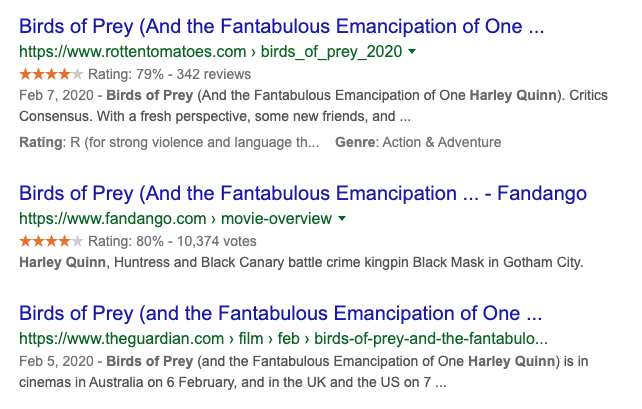
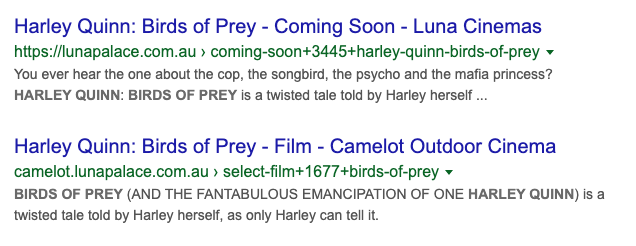
Why is the title important? Anyone, regardless of their enthusiasm for comic book movies will be able to tell you that this is the Harley Quinn movie. In general, Google show a maximum of 60 characters in Search titles, so by positioning her extremely valuable name 55 characters into the title, listings will exclude her name from appearing at all:
Then there was this headline from Forbes which had a healthy dose of irony:
Whereas the truncated title fits perfectly with 30 characters to spare for the website’s name itself, benefiting local Cinemas and review sites alike, all battling for ticket sales and impressions.
The fact of the matter is, Birds of Prey simply doesn’t hold the same level of brand recognition as Harley Quinn does. It isn’t The Avengers, or X-Men (which suffered a similar blunder with Dark Phoenix). Current trends show that it’s only been as recently as this week that Birds of Prey’s search popularity has started to eclipse that of Harley Quinn’s:
If we compare the original title to the truncated title, the latter is 20 times as popular and trending upward as of writing this:
Even adding ‘Harley Quinn Movie’ to the mix illustrates the link between Harley Quinn and the brand’s success:
Objectively speaking, if this were any other service or product that you were searching for and you were presented with search results that didn’t contain the thing that you actually searched for, you’d probably just keep scrolling. You wouldn’t look for plumbers in your area and click a listing that began with 60 characters describing the van they turn up to a job in.
Admittedly, when I first read the original title for Birds of Prey my mind immediately defaulted to a Troy McClure film of undisclosed popularity:
Oddly enough, ‘The Contrabulous Fabtraption of Professor Horatio Hufnagel’ just squeezes in to the 60 character limit, making it slightly more SEO friendly than what I’m writing this article about.
Metatags Aren’t Just For Metahumans
Warner Brothers have been under fire in previous years for strong-arming directors into pre-release title changes, so this could simply just be a change of tact to afford Cathy Yan proper creative control over her film despite the unusually eccentric title raising numerous eyebrows.
Corporate Bean-Counters stepped in to action this unprecedented title change fairly swiftly, speaking volumes about the power of SEO and appropriately structuring your titles to make sure it is seen by as many eyes as possible.
Much like a feature film, your content is a money-making exercise. Business doesn’t run on love alone, you are always investing your time into creating content designed to position you as an expert in your field.
This isn’t saying you can’t be creative with your titles, you just have to be creative in the scope of the platform you’re publishing on. All content delivery methods come with a set of parameters that you must adhere to, which aren’t limited to just movie titles. For example, if you are creating content for TikTok, you wouldn’t use still images. If you are trying to launch a new car model in Portugal, you’d name it the Kauai instead of the Kona. If you were creating a billboard ad for the side of a highway, you wouldn’t use an entire paragraph of text (or would you).
With that said, it’s time for you to start structuring your page titles effectively, they are your ad’s headline in organic search results.
Keep them under 60 characters long
Use your most important elements at the start
Answer a question preemptively (chances are you’re writing the article to answer something anyway)
Promote yourself shamelessly
The key takeaway from this scenario is that if the first title you pick doesn’t hit the mark, that’s ok! If Warner Brothers’ can change a movie title, then you can change your blog post’s title (feature image, excerpt or content for that matter) at any time. That in itself is the beauty of creating content for the digital world, you’re only limited by your attachment to what you create.
This is the first article in a series looking at the attention economy and how online content gets in front of your eyeballs.
You may have read about – or already seen, depending on where you are – the latest tweak to Facebook’s interface: the disappearance of the likes counter.
Like Instagram (which it owns), Facebook is experimenting with hiding the number of likes that posts receive for users in some areas (Australia for Facebook, and Canada for Instagram).
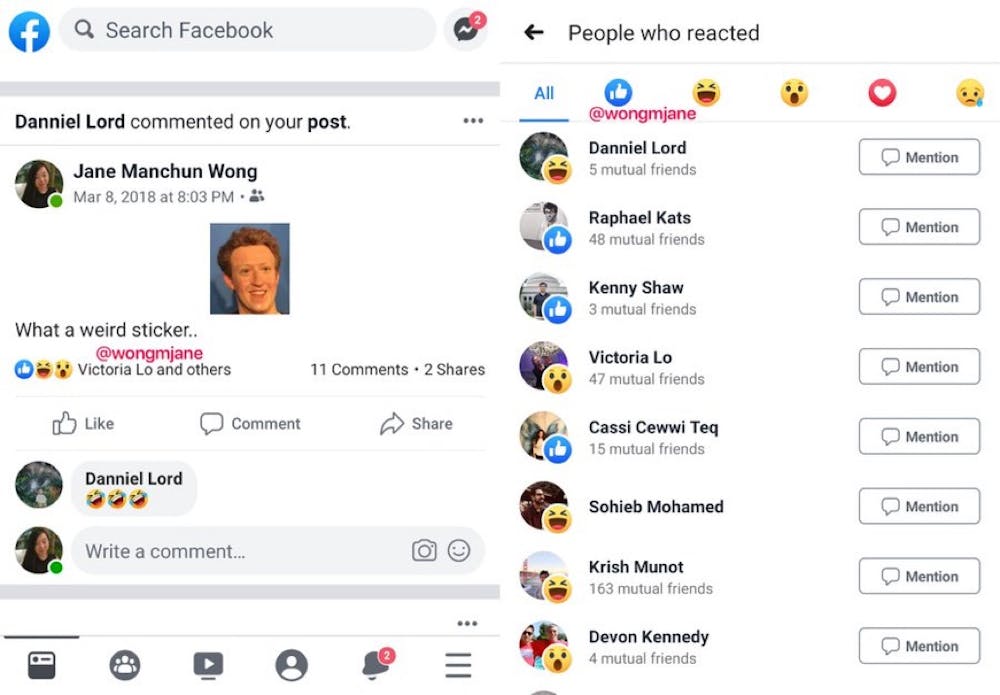
In the new design, the number of likes is no longer shown. But with a simple click you can see who liked the post and even count them.
It seems like Facebook is going to a lot of trouble to hide a seemingly innocuous signal, especially when it is relatively easy to retrieve.
There are also claims about ameliorating user insecurity when posting, perceived liberty of expression, and circumventing the herd mentality.
But are there any scientific grounds for this change?
The MusicLab model
In 2006, US researchers Matthew Salganik, Peter Dodds and Duncan Watts set out to investigate the intriguing disconnect between quality and popularity observed in cultural markets.
They created the MusicLab experiments, in which users were presented with a choice of songs from unknown bands. Users would listen online and could choose to download songs they liked.
The users were divided into two groups: for one group, the songs were shown at random with no other information; for the other group, songs were ordered according to a social signal – the number of times each had already been downloaded – and this number was shown next to them.
A song’s number of downloads is a measure of its popularity, akin to the number of likes for Facebook posts.
The results were fascinating: when the number of downloads was shown, the song market would evolve to be highly unequal (with one song becoming vastly more popular than all the others) and unpredictable (the winning song would not be the same if the experiment were repeated).
Based on these results, Australian researchers proposed the first model (dubbed the MusicLab model) to explain how content becomes popular in cultural markets, why a few things get all the popularity and most get nothing, and (most important for us) why showing the number of downloads is so detrimental.
They theorised that the consumption of an online product (such as a song) is a two-step process: first the user clicks on it based on its appeal, then they download it based on its quality.
As it turns out, a song’s appeal is largely determined by its current popularity.
If other people like something, we tend to think it’s worth taking a look at.
So how often a song will be downloaded in future depends on its current appeal, which in turn depends on its current number of downloads.
This leads to the well-known result that future popularity of a product or idea is highly dependent on its past popularity. This is also known as the “rich get richer” effect.
What does this have to do with Facebook likes?
The parallel between Facebook and the MusicLab experiment is straightforward: the songs correspond to posts, whereas downloads correspond to likes.
For a market of products such as songs, the MusicLab model implies that showing popularity means fewer cultural products of varying quality are consumed overall, and some high-quality products may go unnoticed.
But the effects are even more severe for a market of ideas, such as Facebook.
The “rich get richer” effect compounds over time like interest on a mortgage.
The total popularity of one idea can increase exponentially and quickly dominate the entire market.
As a result, the first idea on the market has more time to grow and has increased chances of dominating regardless of its quality (a strong first-mover advantage).
This first-mover advantage partially explains why fake news items so often dominate their debunking, and why it is so hard to replace wrong and detrimental beliefs with correct or healthier alternatives that arrive later in the game.
Despite what is sometimes claimed, the “marketplace of ideas” is no guarantee that high-quality content will become popular.
Other lines of research suggest that while quality ideas do make it to the top, it is next to impossible to predict early which ones. In other words, quality appears disconnected from popularity.
Is there any way the game can be fixed?
This seems to paint a bleak picture of online society, in which misinformation, populist ideas, and unhealthy teen challenges can freely flow through online media and capture the public’s attention.
However, the other group in the MusicLab experiment – the group who were not shown a popularity indicator – can give us hope for a solution, or at least some improvement.
The researchers reported that hiding the number of downloads led to a much fairer and more predictable market, in which popularity is more evenly distributed among a greater number of competitors and more closely correlated to quality.
So it appears that Facebook’s decision to hide the number of likes on posts could be better for everyone.
In addition to limiting pressure on post creators and reducing their levels of anxiety and envy, it might also help to create a fairer information exchange environment.
And if posters spend less time on optimising post timing and other tricks for gaming the system, we might even notice an increase in content quality.
News organisations and their journalists have been competing for consumers’ eyes and ears for hundreds of years. While the media industry has been turned on its head in the last 20 or so years, many of the principles that underpin competitive journalism have remained unchanged.
Understanding these principles and applying them to your brand’s content strategy will dramatically improve the efficiency and effectiveness of your content.
The concept of a ‘brand newsroom’ is not new. However, unless your newsroom lives and breathes traditional newsroom values it is merely a content production studio. Here are five principles you can apply to your content strategy.
1. Deadline Discipline
While the news cycle for daily and weekly newspapers have changed significantly since the proliferation of online news sites and a digital-first approach, the tyranny of deadlines remains.
Regardless of whether you are the newest cadet at your local weekly paper or a senior columnist at the biggest paper in the country – your day is ruled by deadlines. Some are hourly, some are daily, some are weekly (Saturday editions) and some monthly (liftouts).
Newspaper deadlines are immovable, intractable and policed by irascible editors.
The best content, like news, is fresh. A piece of content that’s not timely can quickly become irrelevant. Building a culture of deadline discipline to your brand newsroom will greatly improve the consistency and timeliness of your outputs.
2. Understand Your Audience
Newsrooms have got creating quality content en masse down to a fine art because it’s their raison d’être. They know that to really get people reading, their content needs to be audience-centric.
A few years ago the Financial Times launched a new digital data dashboard to help journalists and editors in the newsroom better understand their audience and how people interact with stories on the website.
The tool, called Lantern, integrates audience data collected across the entire organisation, which already exists but usually serves business or commercial purposes.
Using Lantern, anyone in the newsroom will be able to find out how their story is doing in real time, but also how the audience engages with it in the longer term.
While developing custom monitoring software is beyond most brands, building a system to monitor traffic, engagement and feedback is critical to understanding your audience and constantly evolving your content to reflect the needs of your audience.
3. Employee Journalists
With so many of the skills and disciplines required to develop highly engaging content learnt in the newsroom, it is little wonder journalists often make the best content producers. Only journalists who have spent a considerable amount of time in a newsroom understand the agility and flexibility required to produce great content on a consistent basis under tight timelines.
Journalists also have specific training in writing great headlines, undertaking thorough research, prioritising accuracy, separating content from fluff, building relationships, writing in news style and understanding complex issues quickly. All of these are invaluable to a brand newsroom.
READ MORE:10 Skills That Make Journalists the Secret Weapon for Your Content Team
4. Apply News Values
Journalists commonly use six values to determine how newsworthy a story or elements of a story are. Knowing the news values can help a journalist make many decisions, including:
– What information to give first in a news article, and in the lede (the lead paragraph)
– Which articles to display on a newspaper’s front page
– What questions to ask in an interview
The six news values are:
Timeliness- Recent events have a higher news value than less recent ones.
Proximity- Stories taking place in one’s hometown or community are more newsworthy than those taking place far away.
Prominence- Famous people and those in the public eye have a higher news value than ordinary citizens.
Uniqueness/oddity- A story with a bizarre twist or strange occurrences. “Man bites dog” instead of “dog bites man.”
Impact- Stories that impact a large number of people may be more newsworthy than those impacting a smaller number of people.
Conflict- “If it bleeds, it leads.” Stories with strife, whether it’s actual violence or not, are more interesting.
The newsworthiness of a story is determined by a balance of these six values. There is no set formula to decide how newsworthy a story is, but in general, the more of these six values a story meets, the more newsworthy it is.
Curate
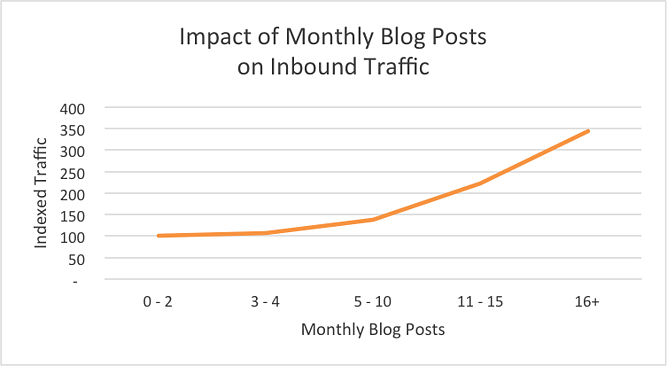
Not every piece of content needs to win a Pulitzer. Volume counts. Recent research by HubSpot found a clear and direct correlation between the number of monthly blog posts and inbound traffic.
Sometimes your job is simply to act as a gatekeeper and curator of other people’s content. Too many brand newsrooms put too much emphasis on creating ‘original’ content.
Sometimes finding and reconextualising a third-party’s content is just as valuable to toy your audience, but infinitely less time consuming and onerous.
For most brands, relying on the product alone is not enough to sustain the ongoing volume required to build and engage with an audience. They need to establish a rich extrinsic brand narrative that can be continuously refreshed.
Conclusion
An effective content strategy is build on the continuous development and broad-based publishing of highly engaging content that builds awareness and drives action.
Delivering an effective content strategy, particularly on a constrained budget, is all about consistency and quality. Learning how newsrooms do this is the first step to creating your own brand newsroom.
Ah, Monopoly. Parker Brothers’ accurate prediction of the current Sydney housing market, and perhaps the leading cause of animosity between family members during power outages.
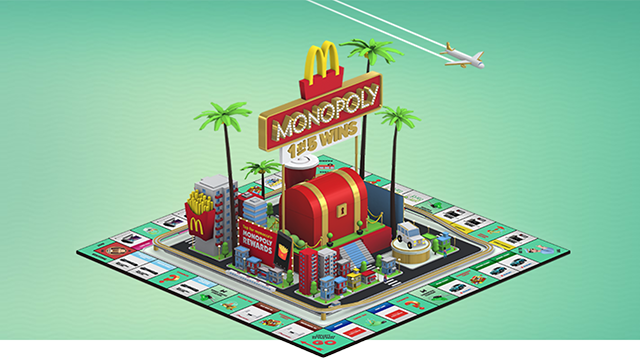
It’s McDonalds Monopoly time, possibly the most obvious example of gamification, where the dynamic duo dangle the veritable deep-fried carrot in front of millions of Australians who are battle-hardened against most marketing efforts of the fast food juggernaught.
Game On
Gamification, simply put – is a marketing campaign masquerading as a game, which serves to bridge the engagement gap between business and customer to improve the likelihood of conversion. This method is proven to increase engagement, loyalty, the consumer experience and above all – move product.
How is gamification profitable? McDonalds simply restrict the quantity of specific pieces of the Monopoly real estate tokens, naturally mitigating any risk associated with too many winners. After all – the game isn’t designed to get you into that brand new Suzuki Vitara, the game is designed to make the business money.
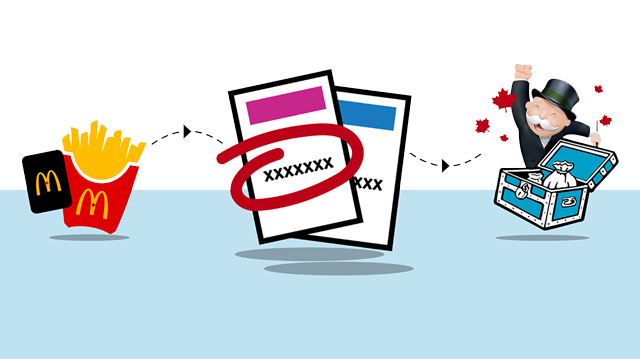
Maccas adds another gamification layer to their marketing in their flashy, yet UX challenged phone app. This provides a modern, yet equally frustrating electronic version on the classic board game, while doubling as a facility to claim and collect your tokens.
But if winning a major prize is statistically improbable, what’s the point? Enter the consolation prize, designed almost entirely to claw you back into the restaurant: ‘Instant Win’ prizes like chips or a small soft drink. When you go to redeem these are they REALLY all you’re going to get? No, you’re likely going to order an entire meal, plus the free fries – because you want those additional tickets. On top of that, Chance Card tokens are also provided as another layer of gamification, unlocking mini-games in the app to win yet more tokens or prizes. Gameception.
Can I Play?
If you haven’t already disappeared to make the hunger-fuelled pilgrimage to the Golden Arches, how can you leverage gamification for your business?
Lets explore the three main tenets of Gamification: building Motivation, Ability & Triggers. Motivation is the dangling carrot enticing the player to play, while Ability enables the player to play by means of providing the playing field (which includes actual prizes), and Triggers get the player off the bench and into the game when they are made to feel the most empowered.
Motivation:
Benefit to You: Breaks down barrier between customer and business, adds another person to the funnel. Benefit to Player: Instills a feeling of easily-achieved win, promise of dopamine kick and tangible ‘prize’.
Ability:
Benefit to You: Nothing intrinsically, this is essentially entirely a liability in terms of costs associated with prizes and marketing. Benefit to Player: Available prizes that people instinctively perceive as goals, while being offered the pathway to achieve that goal by you.
Trigger:
Benefit to You: Customer’s illusion of choice, forced to take action by purchasing product in order to begin the game. Benefit to Player: Starts the game which they have already imagined winning (for a small fee, this holds the most risk for player).
As you can see, this is a zero-sum game when appropriately managed. Where the motivation step benefits both parties, the ability step benefits the player and the trigger benefits the business. Once you’ve quantified your Ability in terms of the value of your marketing investment (prizes, assets & activation), and the Trigger’s value to you (products purchased, emails collected), it’s game on.
Get Your Head In The Game
Obviously a partnership with an international entertainment company is out of the reach of most businesses, so here’s a few good examples of gamification that you could modify to suit your own purposes:
Facebook – Top Fans
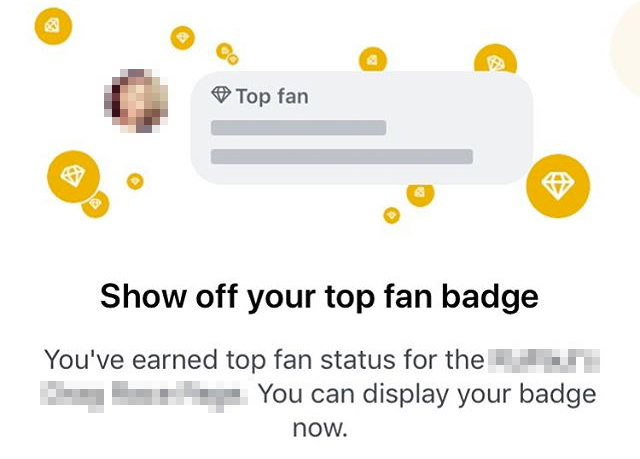
Consistently engage with a page’s posts and you’ll have a shiny badge next to your name to show your loyalty to the business when commenting on their posts. This benefits Facebook by ensuring users stay active, benefits the business by increasing post engagement rates and reach, and benefits the user by rewarding them with bragging rights in the form of a tiny badge.
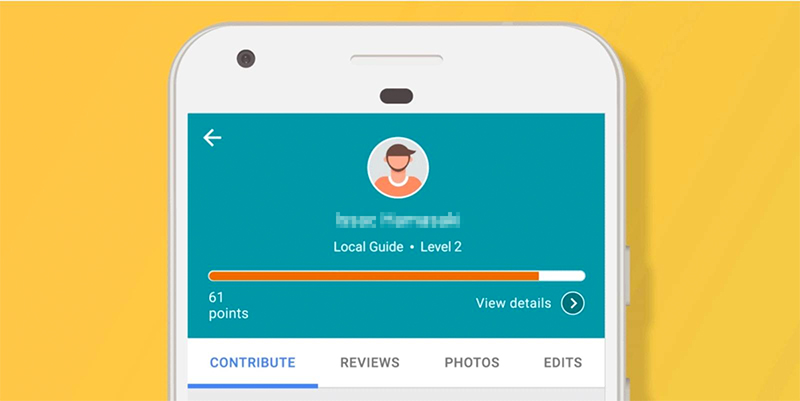
Google Maps – Local Guides Program
Regularly write quality reviews for businesses you visit to increase your profile’s level, earning badges along the way and ascend quicker by writing more comprehensive reviews, or by posting photos and videos. This benefits Google by increasing the value of it’s Maps listings to the end user by bolstering the quantity of submissions while prioritising quality content. Most importantly though, it benefits the business by means of social proofing, boosting perceived trust in the business and promoting it’s good deeds (and punishing bad customer service). Also benefits the reviewer’s profile by positioning them as an authority in their area, and sometimes, winning tangible prizes like socks.
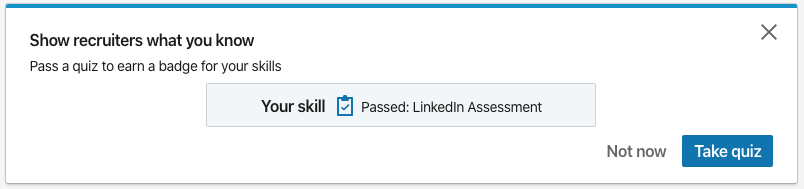
Linkedin – Profile Completion Awards
Microsoft want you to complete your Linkedin profile a lot further than your name and a photo, and do so by awarding you a self-esteem boosting award to say you’re using the platform effectively. This little feature benefits Linkedin by improving the average profile completion rate, ensuring they stay competitive in a Facebook-controlled ecosystem and above all, increasing the amount of increasingly-valuable user data available to them. This also benefits businesses advertising on the platform by giving a strong insight into who the humans in their sphere (both employees and clients) are, and what makes them tick. Your willingly-surrendered data isn’t simply cast into the aether, it does benefit you by building your personal brand, and ensuring you stay competitive (ie: employable and relevant) in your own field.
Asana – Task Completion Narwhal
Asana is a project management tool which rewards habitual task-completers with a cheerful flying narwhal that flies across the screen every so-often when tasks are marked as complete. This simple animation benefits Asana by catering to younger professionals with this fun imagery, benefits the business using the platform by incentivising task completion, and benefits the user by offering a monotony-busting, unexpected surprise for doing something as simple as ticking a box.
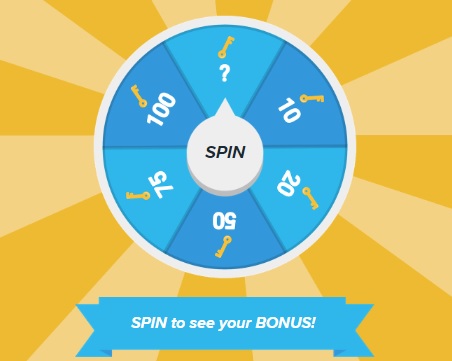
eCommerce – Spin-To-Win
This appears most notably on Wish, where you’re given an opportunity to spin a wheel to win the chance to unlock an extra discount on a number of products dependent on the result of your spin. On other eCommerce websites, this is often a variable ($/%) discount on advertised products which is awarded in the same manner. This Wheel of Fortune benefits the merchant by potentially moving the price-conscious consumer closer to conversion with a small chance-based discount, and benefits the user by appealing to their FOMO, and saving them a small amount on an item they desire. Bonus round: Add a data capture element to this by asking for an email address to unlock the spin.
Interested in learning more about gamification and how it can improve your conversion rates? Get in touch, I’d love to talk about how this strategy can put a fun spin on your next campaign.












 Michele Levine, chief executive of research firm Roy Morgan, said podcasts are growing in popularity in Australia with nearly 10% of Australians now downloading audio or video podcasts in an average month: