

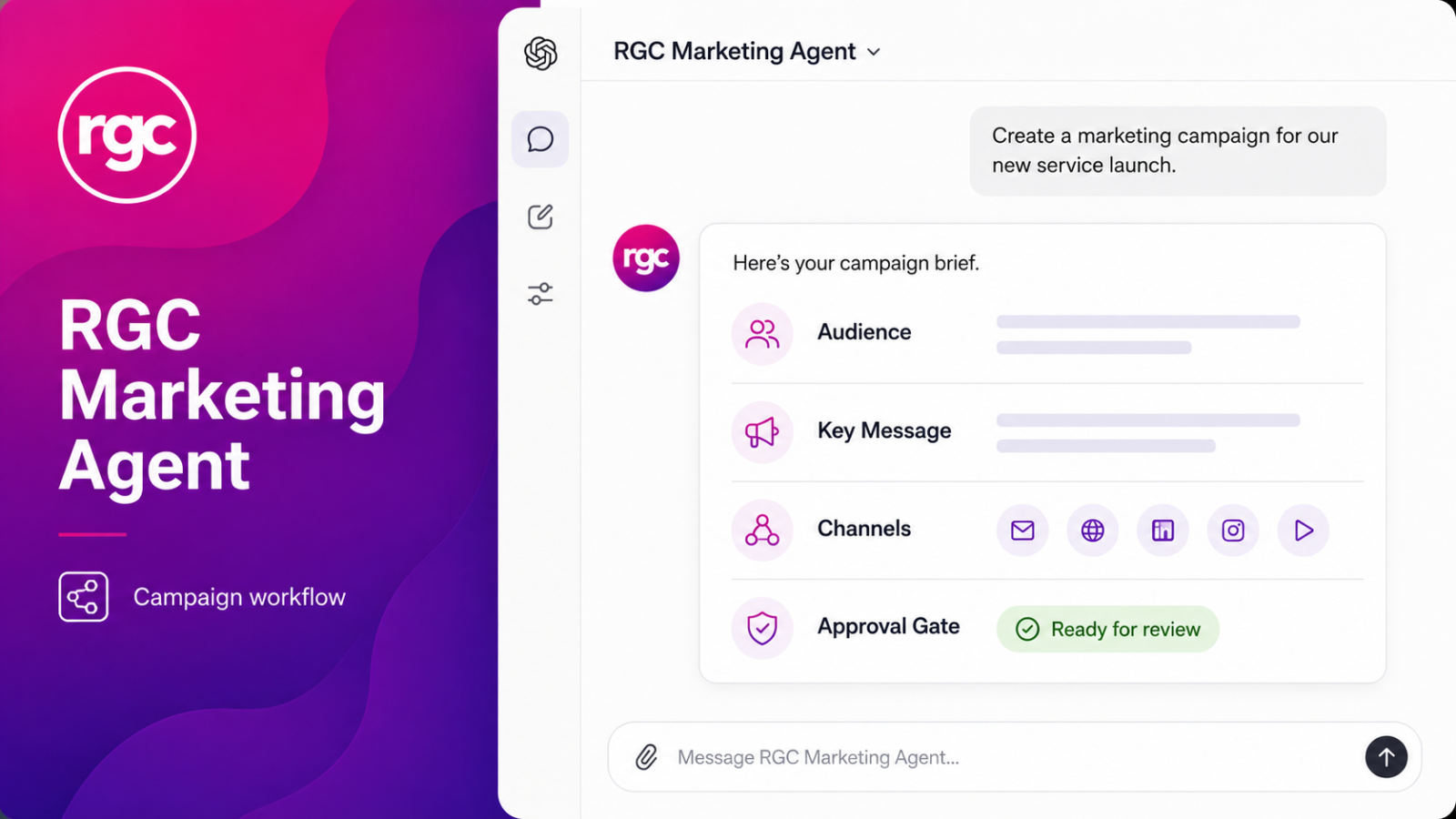
RGC Media & Marketing now builds custom marketing agents in ChatGPT to automate defined marketing workflows, connect teams with approved brand knowledge and reduce repetitive production tasks.
A marketing agent combines instructions, reference material, workflow logic and connected tools inside a controlled ChatGPT environment. Teams can configure an agent to follow specific processes, use approved sources, generate structured outputs and pause at designated approval points.
These agents do not replace marketing strategy or editorial judgement. They handle repeatable tasks, enforce defined rules and give marketing teams a consistent operating layer for content, publishing, analysis and reporting.
RGC can build agents for workflows including the following.
1. Content development and integrated social publishing
A content agent can manage work across multiple stages of the publishing process.
The workflow can accept a structured brief containing the audience, objective, topic, keywords, channels and calls to action. It can then research the subject using approved sources, create an outline and generate channel-specific content.
From one brief, the agent might produce:
- A long-form website article
- LinkedIn and other social posts
- Email newsletter copy
- Metadata and page descriptions
- Image briefs and alt text
- Suggested internal links
The agent can apply different formatting and length rules to each output while maintaining the same core message.
Where the publishing platforms support an appropriate connection, the workflow can send approved content to a content management system, social scheduling platform or marketing automation tool. Permissions and approval gates can prevent the agent from publishing content before an authorised user reviews it.
2. Comprehensive custom brand skills
RGC can build a custom brand skill that gives ChatGPT a defined set of brand-specific instructions and knowledge.
A brand skill converts static brand documentation into an operational resource. It can include tone-of-voice rules, messaging pillars, product information, audience profiles, preferred terminology, prohibited language, formatting conventions, compliance requirements and approved evidence.
The skill can also contain reusable workflows and templates for articles, media releases, social posts, case studies, proposals and campaign briefs.
When a team activates the skill, ChatGPT applies these rules to relevant tasks. This approach reduces the need for users to paste lengthy brand instructions into every prompt. It also gives teams a more consistent way to update brand knowledge and distribute it across repeatable workflows.
The agent can validate draft content against the skill and flag unsupported claims, missing information or deviations from the approved style before the content moves to review.
3. AI search visibility analysis
An AI search visibility agent can test how frequently and accurately AI platforms represent a brand across a controlled set of prompts.
The workflow can group prompts by topic, audience, customer intent and stage of the buying process. It can record whether an AI response mentions the brand, which competitors appear, what sources support the response and how accurately the response describes the organisation.
The agent can compare results over time and identify patterns such as weak topic association, inconsistent descriptions, missing citations or low visibility for high-value queries.
It can then map those findings against the organisation’s existing website content and identify gaps in service pages, FAQs, structured information, expert commentary, case studies and supporting evidence.
This produces a repeatable measurement process rather than relying on occasional manual searches.
4. Campaign reporting and analysis
A reporting agent can ingest structured data from advertising, analytics, CRM, email and social platforms through approved integrations or uploaded files.
It can standardise naming conventions, calculate agreed metrics and compare performance with campaign targets or previous reporting periods. The agent can then generate different reporting views for executives, clients and delivery teams.
Rule-based checks can flag anomalies such as sudden cost changes, incomplete tracking, inconsistent campaign tags or unusual conversion movements. The agent can summarise the data and surface issues, but the marketing team retains responsibility for interpreting results and deciding what action to take.
A structured approach to marketing automation
Effective marketing agents require more than a prompt. They need current source material, explicit workflow logic, defined permissions, quality-control checks and clear human approval points.
RGC builds these components around specific marketing processes so teams can use ChatGPT as a controlled workflow system rather than an isolated content-generation tool.